Boric Acid for Termites: Does It Work?
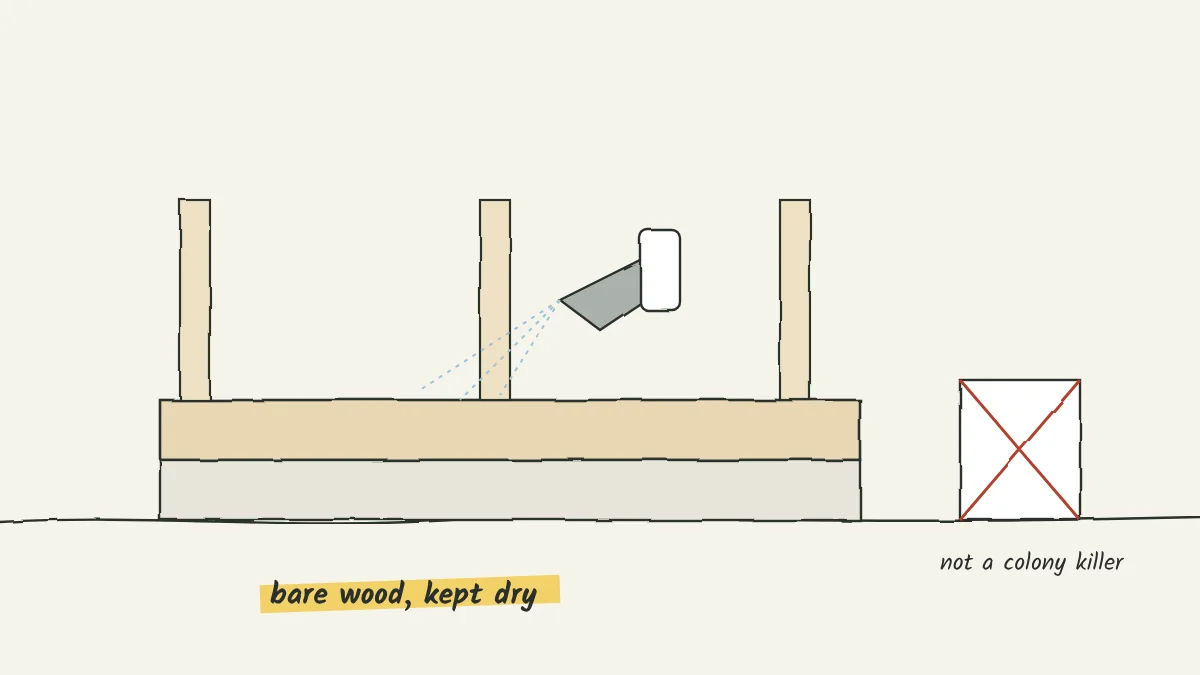
Boric acid kills termites. That part is true. Whether it will stop the termites in your house depends almost entirely on where it goes: soaked into bare wood before termites arrive, it's one of the best-tested protections there is; sprinkled around a baseboard, it does very little. Here's the difference.
The short version
Borates, the family that includes boric acid and borax, work as a wood treatment. Soaked into bare wood, they protected house sill plates from Formosan and native termites for at least five years in field tests. They don't create a soil barrier, they wash out of wood exposed to rain, and boric acid powder won't eliminate a colony. Use borates for prevention, not as a cure.
On this page
How borates kill termites
Boric acid and the sodium borates such as borax have been registered as pesticides in the U.S. since 1948. The National Pesticide Information Center explains that insects that eat boric acid are poisoned, as it disrupts the stomach and affects the nervous system. University of Hawaii researchers describe borates as a slow-acting stomach poison for termites, after which termites limit their feeding on the treated wood.
That slow action is the key to both their strength and their limit. Borates protect wood that termites try to eat. They don't repel termites, they don't travel through soil to a colony, and a termite that isn't eating treated wood isn't affected.
What field tests found on wood
Borates' best evidence is as a wood preservative. In a five-year field test by University of Hawaii researchers and their partners, house sill plates treated with disodium octaborate tetrahydrate stayed free of termite attack at both treatment levels tested, while untreated wood was heavily damaged. Most of the attack came from Formosan termites, and the Hawaii site attacked untreated wood up to ten times faster than the Japan site. Termites still grazed the surface of treated wood occasionally, which the authors attribute to borates not being repellent.
Not every result is that clean. A 2006 U.S. Forest Service study of treated spruce-pine-fir lumber exposed in Louisiana found some borate-treated pieces were attacked even with what looked like complete boron penetration, and that termites went for the centers of end grain, where less preservative reached. Formosans did more damage than native termites across all treatments. The takeaway is that how deep and how evenly the borate gets in matters.
Where borates fit, and where they don't
From University of Hawaii, U.S. Forest Service, Texas A&M and University of Arizona research and guidance.
| Use | Works? | Why |
|---|---|---|
| Bare framing during construction | Yes | Soaks into wood before termites arrive; widely used in Hawaii |
| Sill plates and wood above ground, kept dry | Yes | Field tests showed years of protection out of the rain |
| Wood exposed to rain or soil | No | Borates leach out readily in water |
| Soil around the foundation | No | Borates don't form a soil barrier |
| Dusting baseboards or walls with powder | No | Kills termites that touch it, not the colony |
| Carpenter ants | No | Texas A&M says boric acid dust isn't effective against them |
Borates have to soak into the wood, which is why they go on bare framing during construction.
Leaching is the big limit
Borates dissolve in water. The Hawaii researchers restricted their sill-plate test to protected, above-ground conditions because borates leach readily in running water, and even noted condensation dripping in the test boxes as a long-term concern. Austin's Grow Green termite guide makes the practical version of the same point: borates need a sealer coat to prevent leaching. That's why borate-treated wood is used for framing inside the building envelope, not for fence posts, deck footings or anything in the dirt. For wood that has to be outdoors or in soil contact, the building code calls for ground-contact preservative treatment instead. See termite-resistant wood.
How builders use borates
Borates are common in new construction, especially where termite pressure is highest. University of Hawaii entomologist Ken Grace notes that the most commonly used wood preservative in Hawaii is a disodium octaborate tetrahydrate product. University of Arizona Extension describes borates applied to bare framing up to two to four feet above the sill plate during construction, and Texas A&M says borate wood treatments work best on structural wood before or during building. In those uses, borates are one layer of protection alongside a soil treatment, bait or physical barrier. More in termite pretreatment.
Using borates against termites
Do
- Apply borates to bare wood before finishing or during construction
- Use them on wood that stays dry, above ground
- Combine them with a soil treatment, bait or barrier
- Keep powders away from pets and children
Don't
- Expect boric acid powder to eliminate a colony
- Use borate-treated wood in soil or rain
- Count on a surface spray to reach the center of thick timbers
- Rely on boric acid dust for carpenter ants
Questions people ask
Does boric acid kill termites?
Yes, termites that eat enough of it. But boric acid powder won't reach a colony in the soil, so it won't stop an infestation. Borates work best soaked into bare wood as a preservative.
How long do borate wood treatments last?
In a five-year field test, borate-treated sill plates kept dry and above ground stayed free of termite attack. Borates leach out of wood exposed to rain or soil, so protection depends on keeping the wood dry.
Can I use borax instead of a termite treatment?
Not for an active subterranean infestation. Borax and boric acid don't form a soil barrier or reach the colony. A licensed treatment, such as a liquid barrier or bait system, is the way to stop termites already in the house.
Is boric acid safe around pets?
It has low toxicity on contact, but swallowing it can make pets sick, with signs starting within about two hours, according to NPIC. Keep it out of their reach.
Keep reading
Termites in your state
Sources
- National Pesticide Information Center: Boric acid general fact sheet (2013)
- Tsunoda, Grace, Byrne and Morris: Effectiveness of disodium octaborate tetrahydrate in controlling subterranean termite attack and decay of house sill plates
- Lebow and others, U.S. Forest Service: Formosan and native subterranean termite attack of pressure-treated SPF wood species exposed in Louisiana (2006)
- Grace, University of Hawaii: Termites in Hawaii (2009)
- University of Arizona Cooperative Extension AZ1356: Termite management for homeowners (2005)
- Texas A&M AgriLife Extension E-412: Carpenter ants
- Texas A&M AgriLife Extension: Subterranean termites (E-368)
- City of Austin Grow Green: Termites