How Termite Chemicals Are Regulated: EPA, Labels, States
The jug of termiticide that goes into the soil around your house has been through federal registration, years of field testing in four states and, in many places, a second review by your state. Here's how that system works, and how to use it to check what a company is putting in your yard.
The short version
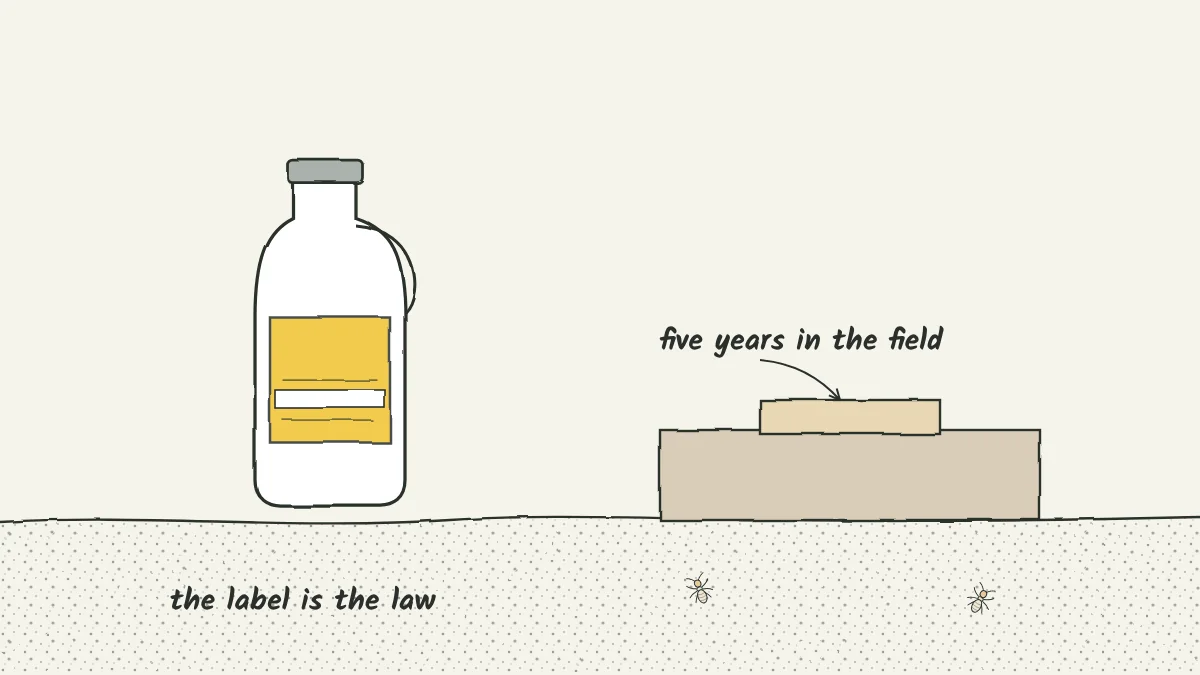
Termiticides are registered by the EPA under FIFRA, the federal pesticide law, after review of health and environmental risks. EPA also looks at five-year field tests, many run by the U.S. Forest Service at sites in Arizona, Florida, Mississippi and South Carolina. States register products too, license the applicators and set treatment standards. The label is legally binding.
On this page
Step one: EPA registration
Pesticides in the U.S. are governed by FIFRA, the Federal Insecticide, Fungicide, and Rodenticide Act, passed in 1947 and administered by the EPA. The national pesticide applicator training manual summarizes EPA's role: it registers pesticides after evaluating risks to human health and the environment, approves the label, and can halt the sale or use of a pesticide at any time.
Every registered product carries an EPA registration number on its label. Termidor SC, for example, is EPA Reg. No. 7969-210. That number lets anyone look up the product and its label.
What registration does and doesn't mean:
- It means EPA reviewed the product's risks and approved specific uses, rates and precautions.
- It doesn't mean EPA endorses a company, and it doesn't certify that a particular job was done right. Those are the state's business.
Step two: proving it works in the ground
For soil termiticides, efficacy comes from long-term field tests. The USDA Forest Service has run a termiticide testing program for decades, with roots in termite work that began in the late 1930s. A 2013 Forest Service report describes how it works:
- Four field sites, in Arizona, Florida, Mississippi and South Carolina.
- Two test designs set by EPA's guideline OPPTS 810.3600: a pine board on treated soil, and a treated soil plot covered by a vapor barrier and a poured concrete slab with a pine block underneath.
- Ten replicates per concentration at each site, with damage scored every year from 0 (none) to 5 (destroyed).
EPA's benchmark, per that report, is that a candidate product should keep termites from getting through treated soil in every test plot for at least five years in the concrete slab test, at the lowest label rate. The report adds a candid caveat: EPA sometimes registers products that don't strictly meet the guideline, because registration weighs toxicology and environmental impact more heavily than efficacy.
Who does what
Several agencies touch the same jug of termiticide. Here's the division of labor.
| Who | What they do |
|---|---|
| EPA | Registers products, approves labels and uses, can halt sale or use |
| USDA Forest Service | Runs long-term field efficacy tests that EPA considers |
| State lead agency | Registers products for sale in the state, certifies applicators, enforces federal and state pesticide law |
| State pest control regulator | Licenses termite companies and sets minimum treatment standards (sometimes the same agency) |
| The label | Legally binding instructions every applicator must follow |
The state agency is usually the department of agriculture. See how to check a pest control license.
Step three: the state's turn
States add their own layer. The applicator manual notes that states often have stricter laws than the federal minimum, and that a state can register an additional use of a federally registered product for a special local need.
A few examples from the states we cover:
- South Carolina allows only termiticides registered in South Carolina, applied at label rates or higher.
- Georgia's consumer office says pesticide products must be registered with both EPA and the Georgia Department of Agriculture.
- Louisiana's agriculture department publishes a list of approved termiticides and their manufacturers.
- Florida goes further for new construction: products used for preventive treatments must meet a state performance standard, which the Forest Service report describes as keeping damage minimal on more than 90 percent of test plots for five years at one or more Southeastern sites.
State treatment standards go beyond the label
Many Southern states don't stop at the label. They write minimum standards for how a termite job is done:
- Louisiana specifies trenches about 4 inches wide and 6 inches deep along the foundation and slab drilling no more than 18 inches apart, among other details.
- South Carolina specifies masonry voids drilled at 16-inch intervals or less and slab-edge drilling at 12 inches or less.
- Georgia inspects termite jobs against its standards and can require corrections within 30 days.
If a treatment fails, those standards are what a state inspector measures the job against. See liquid termite treatment for how the work is done, and how to file a complaint if it isn't.
How to check what's going on your house
-
Get the product name
Every proposal should name the product. Texas requires it, with the label.
-
Find the EPA registration number
It's on the label. Search it to read the full, current label.
-
Read the use directions
Look for the soil application rate, the areas it may be used, and what it says about wells, pets and re-entry.
-
Ask whether it's registered in your state
Most will be, but state registration is a separate step. Your state department of agriculture can confirm.
-
Match the plan to the standards
If your state has minimum treatment standards, ask the company how the job meets them, and keep the treatment diagram.
Questions people ask
Who approves termite chemicals?
The EPA registers termiticides under the federal pesticide law, FIFRA, after reviewing health and environmental risks. States also register products for sale, certify the people who apply them and, in many cases, set minimum treatment standards.
How are termiticides tested?
Soil termiticides are tested for years in the field. The USDA Forest Service runs tests at sites in Arizona, Florida, Mississippi and South Carolina using EPA's guideline, and EPA's benchmark is that treated soil stops termites in every plot for at least five years in the concrete slab test.
What does "the label is the law" mean?
The pesticide label is a legal document. Applicators must follow its directions on rates, placement and precautions, and any use inconsistent with the label is a violation of federal law.
Does EPA registration mean a termiticide works?
Efficacy data is part of the picture, but a Forest Service report notes EPA weighs toxicology and environmental impact heavily and sometimes registers products that don't strictly meet its efficacy guideline. A product's long-term field record is worth asking about.
Keep reading
Termites in your state
Sources
- National Pesticide Applicator Certification Core Manual, Chapter 2: Federal pesticide laws
- USDA Forest Service: Termiticide report for 2013
- U.S. EPA: Termidor SC label, Reg. No. 7969-210
- UF/IFAS EDIS IN278: Formosan subterranean termite (performance standards)
- South Carolina Regulation 27-1085: Standards for wood-destroying organisms
- Georgia Consumer Protection Division: Pest control and exterminators
- LDAF: Structural pest control
- Louisiana Administrative Code 7:XXV.141: Minimum specifications for termite control work
- Georgia Department of Agriculture: State inspections fact sheet
- Texas Administrative Code, 4 TAC 7.174: Termite treatment disclosure documents