Termites in Atlanta: Natives, a Few Formosans and Historic Rules
Most Atlanta termite stories start with a swarm of small dark insects on a warm February or March afternoon. A few start somewhere stranger: with a landscape timber that came from New Orleans. Here's what metro Atlanta homeowners need to know about both, plus how the city's historic districts handle repairs.
The short version
Atlanta's main termite is the native subterranean termite, which swarms in daylight starting in February or March. Formosan termites are rare in Georgia, but most of the colonies found in the state's early-2000s initiative were in metro Atlanta, and DNA traced them to New Orleans. In historic districts like Inman Park, ordinary repairs don't need a Certificate of Appropriateness.
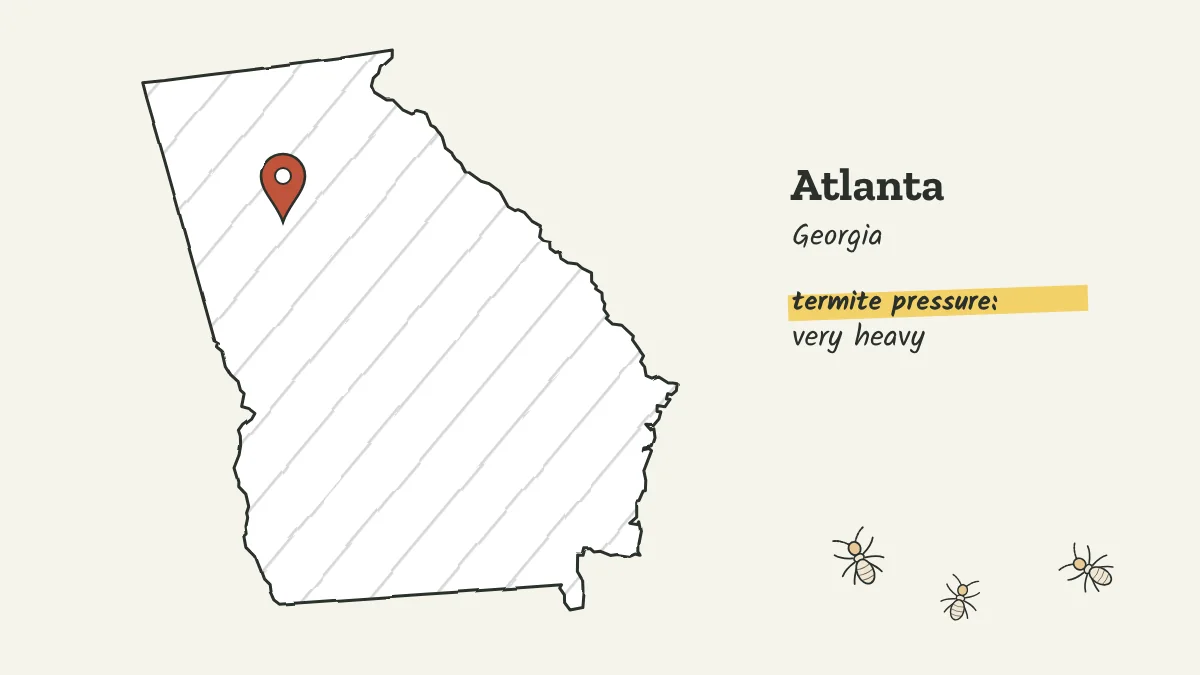
Atlanta at a glance
- Termite pressure
- Very heavy
- Termites to know
- Eastern subterranean, Formosan subterranean
- Why termites like it here
- Hot, humid summers and mild winters, with native subterranean termites everywhere and scattered Formosan colonies across the metro area.
- Who licenses pest control
-
Georgia Department of Agriculture, Structural Pest Control Section
Check a company's license - Inspection report for home sales
- Official Georgia Wood Infestation Inspection Report
On this page
How New Orleans termites got to Atlanta
The Formosan subterranean termite came into U.S. ports after World War II. It didn't fly to Atlanta. According to UGA, it's believed to have left New Orleans in railroad crossties used as landscape timbers, and UGA's DNA research confirmed that Georgia's Formosans came from the New Orleans introductions. LSU AgCenter makes the same point from the other end: DNA testing traced an infestation in Atlanta to railroad ties from New Orleans.
When the Georgia General Assembly funded a three-year Formosan initiative, ending in 2003, UGA Extension entomologist Dan Suiter and colleagues located, destroyed and monitored 16 confirmed colonies, and most of them were in metro Atlanta. Mississippi's Formosan quarantine rule, which tracks infested areas in other states, lists five metro counties: Cobb, DeKalb, Fayette, Gwinnett and Paulding.
Keep that in proportion. UGA still describes the Formosan termite as rare in Georgia, and Suiter is explicit that railroad ties in a landscape don't by themselves mean Formosans are present. They're a reason to have old ties checked, not a reason to panic. The spread story is in Formosan termite quarantine laws.
The termite you'll actually meet
The native subterranean termite does almost all of Atlanta's termite damage. UGA Extension says natives begin swarming in February or March, fly during the day, and aren't drawn to lights. The swarmers are black and about three-eighths of an inch long.
UGA entomologist Brian Forschler's advice for the moment you see them inside: don't panic. A swarm isn't an emergency, though it does mean a colony is close and an inspection is due. His bigger advice is to get bids from several companies, compare the control options and the contracts, read what the warranty covers and try to lock in the renewal rate. The morning-after checklist is in termites swarming in your house.
Is it a native or a Formosan?
Atlanta has both, so it's worth knowing the difference. From UGA Extension Circular 868.
| Clue | Native | Formosan |
|---|---|---|
| When it swarms | February or March, daytime | Late May and early June, at night |
| Lights | Not attracted | Strongly attracted |
| What the swarmer looks like | Small and black | Larger, with a caramel to yellowish-brown body |
| Soldier | Fewer soldiers, no white secretion | 15 to 20% soldiers; white, glue-like drop |
If you think you've caught Formosans, UGA asks for several swarmers or soldiers in a vial of rubbing alcohol, sent to its entomology department on the Griffin campus. Your county UGA Extension office can help.
Repairs in a historic district
Atlanta's historic districts, from Inman Park and Grant Park to Adair Park, West End, Whittier Mill and the Druid Hills Landmark District, are overseen by the city's Urban Design Commission, which issues Certificates of Appropriateness in several types.
For termite repairs, the useful detail is at the bottom of the ladder. The Inman Park neighborhood association explains that in its district, a Type I Certificate of Appropriateness for ordinary repairs and maintenance isn't required. Bigger changes are another matter: Type III certificates go to the commission, which considers neighborhood support, and Inman Park encourages a neighbors' meeting and a presentation at the neighborhood association first.
Windows are where repairs often turn into changes. In 2016 the commission denied a variance on Hopkins Street for replacement windows that didn't match the original openings. If termites or rot have eaten a window frame, repair or replace it to the original size and pattern, and check your district's guidelines before ordering anything. Not sure whether you're looking at termites or rot? See termite damage vs water damage.
Georgia's rules, briefly
Atlanta homeowners get the full protection of Georgia's rules, which are covered on the Georgia termite page: minimum treatment standards, an Official Waiver for anything a company can't treat, state inspections of termite jobs with 30 days to correct deviations, and the Official Georgia Wood Infestation Inspection Report for home sales. Licenses can be checked on the state's structural pest control search.
For Atlanta homeowners
Do
- Have old railroad-tie walls and beds checked by a termite professional
- Note whether a swarm came by day or by night
- Get bids from several companies and compare the warranties
- Call your neighborhood's historic preservation contact before exterior changes
Don't
- Bring used crossties or timbers home from the Gulf Coast
- Assume ties in the yard mean Formosans; UGA says they don't
- Replace historic windows with different sizes without approval
- Sign the same day as a free inspection
Questions people ask
When do termites swarm in Atlanta?
The natives fly first, on daytime afternoons from February or March on. The rare Formosans wait until the end of May and the start of June, flying after dark and heading for porch lights.
Are there Formosan termites in Atlanta?
A few. Most of the 16 colonies Georgia's Formosan initiative found and destroyed by 2003 were in metro Atlanta, and DNA traced them to New Orleans, likely via railroad ties. UGA still describes the species as rare in Georgia.
Do I need approval to repair termite damage in an Atlanta historic district?
Often not for ordinary repairs. In Inman Park, for example, a Type I Certificate of Appropriateness for ordinary repairs and maintenance isn't required. Changes to design or materials need review by the Urban Design Commission.
Who checks termite companies in Atlanta?
The Georgia Department of Agriculture licenses companies and inspects termite work statewide. Its Structural Pest Control Division is at 404-656-3641.
More in Georgia
Keep reading
Sources
- UGA CAES: Georgia initiative fights ferocious alien termite (2003)
- UGA Extension Circular 868: Identifying the Formosan subterranean termite (2022)
- UGA CAES: Don't panic when termites swarm, says UGA scientist (1999)
- LSU AgCenter: Formosan termite numbers rising in East Baton Rouge and Louisiana (2015)
- Mississippi Administrative Code 2-1-3-01-135: Formosan subterranean termite quarantine
- City of Atlanta: Urban Design Commission results, February 10, 2016
- Inman Park Neighborhood Association: Historic preservation
- Georgia Department of Agriculture: Structural pest control