Termites in Charleston, SC: Where America's Formosan Story Began
Charleston has lived with Formosan termites longer than anywhere else on the U.S. mainland. Clemson entomologists have studied them here since the 1980s, and the city's historic houses add their own rules for fixing what termites eat. Here's the Lowcountry version.
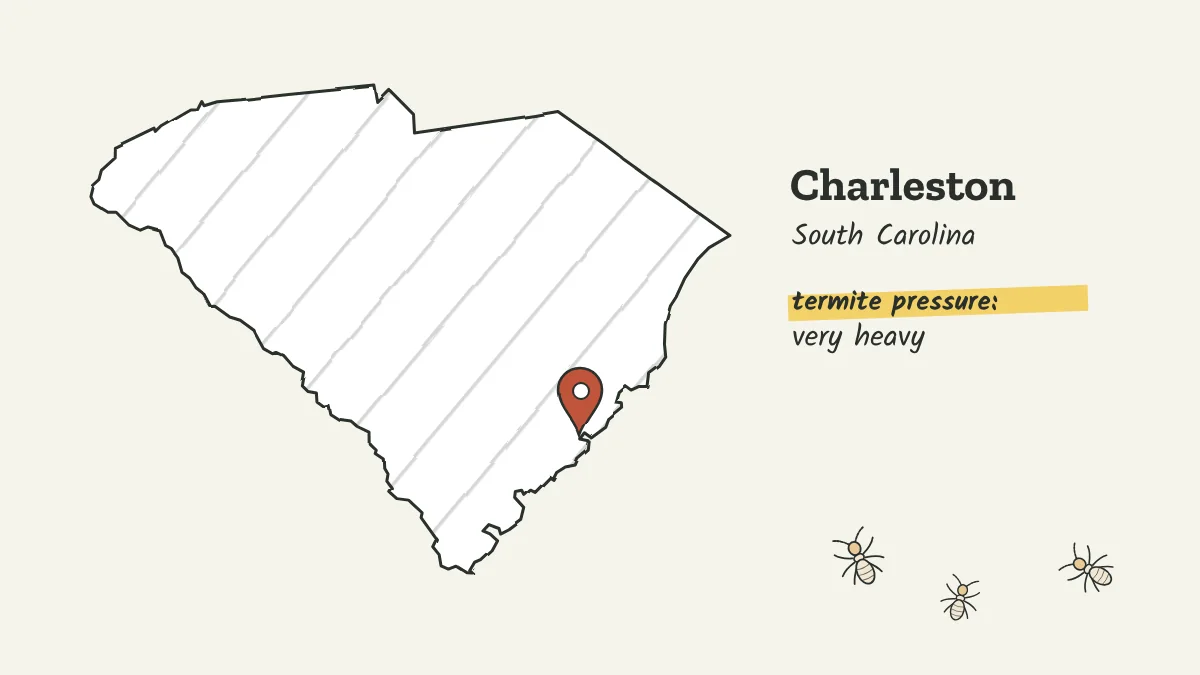
The short version
Formosan termites have been in Charleston since at least 1957, when the first specimen on the U.S. mainland was collected here. They're established in many parts of Charleston County and swarm on late-spring evenings toward lights. Native subterranean termites swarm on early-spring afternoons, and drywood termites turn up in coastal buildings. Exterior repairs in historic districts go through the Board of Architectural Review or its staff.
Charleston at a glance
- Termite pressure
- Very heavy
- Termites to know
- Formosan subterranean, Eastern subterranean, Southeastern drywood
- Why termites like it here
- Hot, humid and coastal, with Formosan termites established in many parts of the county, native subterranean termites everywhere and drywood termites in older buildings.
- Who licenses pest control
-
Clemson University Department of Pesticide Regulation
Check a company's license - Inspection report for home sales
- Official South Carolina Wood Infestation Report (the CL-100)
On this page
Where the mainland story starts
The Formosan subterranean termite arrived in American port cities on ships returning from the Pacific after World War II. According to New Orleans city entomologists' history of the species, the first specimen collected on the continental U.S. came from Charleston in 1957, though it wasn't positively identified until 1969. Clemson Extension dates South Carolina's introduction to the 1950s.
Charleston has been the state's center of gravity ever since. Clemson's statewide survey found Formosans established in many areas of Charleston County, with records in neighboring Berkeley and Dorchester counties. By 2022, Clemson Extension entomologist Eric Benson described them as most concentrated from Charleston south to Beaufort. A county listing doesn't mean every neighborhood has them; it means some areas have established colonies.
What Clemson learned here
Clemson researchers studied Formosan colonies in Charleston in the 1980s, and one finding still matters for every house in the city: about 6 percent of the 50 Formosan colonies they studied were aerial, living above ground in a building with no soil connection, fed by moisture from a leak.
That's why Clemson's advice for Formosan country is to have the whole house inspected, foundation to roof, not just the first floor. A colony in a second-story wall behind a slow plumbing leak won't show up at the foundation. Benson's other message is that this is a known, solvable problem: Formosans respond to the same treatments as native termites, and Lowcountry homes have been kept safe from them for decades.
Clemson entomologist Pat Zungoli told The Post and Courier that homeowners don't need to be frightened, but should get regular inspections and act promptly when termites are found, and she noted that a mild winter can mean a longer reproductive season and bigger swarms. Treatment details are in Formosan termite treatment.
Charleston's termites side by side
Based on Clemson Extension's Home and Garden Information Center.
| Termite | When you'll notice it | What gives it away |
|---|---|---|
| Formosan subterranean | Evenings, mid-May into July, toward lights | Golden-brown swarmers about 1/2 inch; damage high in walls near leaks |
| Native subterranean | Early spring afternoons | Dark swarmers about 3/8 inch; mud tubes on piers and foundations |
| Eastern drywood | Year-round signs | Hard pellets below small holes; Clemson found it in coastal counties |
| West Indian drywood | Rarely | Pellets in a building; Clemson recorded it in Charleston County, only ever in structures |
The drywood termites guide covers pellets and treatment. Questions can go to Clemson's Home and Garden Information Center at 1-888-656-9988.
Old houses, the BAR and termite repairs
Charleston's historic districts fall under the city's Board of Architectural Review (BAR), and termite or rot damage to porches, siding, trim and windows on a historic house usually means BAR rules apply. The good news is in the board's 2024 staff review policy: city staff may process exterior repairs that don't change the appearance of the structure, along with painting and several other minor items, without a board hearing.
What goes to the board: alterations to Category 1 and 2 structures beyond repair, in-kind work, signage and painting; painting previously unpainted masonry; and changes that downgrade an earlier BAR approval. Staff can also refer any application to the board.
For termite repairs, that suggests a simple rule of thumb: repair or replace what was eaten so the house looks the same, and staff can likely handle it. Change the look, the material or the design, and plan for the board's calendar. If you're not sure whether termites or rot did the damage, start with termite damage vs water damage.
Buying in the Lowcountry
Charleston home sales use the state's Official South Carolina Wood Infestation Report, known as the CL-100. It requires moisture readings and probing of damaged wood, and it must report damage even if it's been repaired. On a Charleston house, read the page listing areas that couldn't be inspected; a finished attic or a closed-off wall is exactly where an aerial colony could hide.
If the house has a termite bond, South Carolina rules require the contract to say whether it covers Formosans and whether that means retreatment only or repair too. That one clause matters more here than almost anywhere. The details are on the South Carolina termite page.
Charleston short list
Do
- Turn off porch lights on May and June evenings
- Have the whole house inspected, attic included
- Fix leaks quickly; aerial Formosan colonies live on them
- Find the Formosan clause in any termite bond
- Check with BAR staff before exterior repairs on a historic house
Don't
- Assume a clean foundation means a clean house
- Use old railroad ties in retaining walls or beds
- Change siding or windows on a historic house without approval
- Panic at one swarm; get an inspection
Questions people ask
Are there Formosan termites in Charleston?
Yes. The first Formosan termite collected on the U.S. mainland came from Charleston in 1957, and Clemson Extension says they're established in many parts of Charleston County and most concentrated from Charleston south to Beaufort.
When do termites swarm in Charleston?
Formosan termites swarm on evenings from mid-May into July and fly toward lights. Native subterranean termites swarm in early spring, usually in the afternoon.
Can termites live in the upper floors of a Charleston house?
Formosans can. A Clemson study of Charleston colonies found about 6 percent were aerial, living above ground on moisture from a leak, which is why Clemson recommends inspecting the whole house, foundation to roof.
Do I need BAR approval to repair termite damage in Charleston?
Exterior repairs that don't change a building's appearance can be processed by city staff under the Board of Architectural Review's staff policy. Changes in design or materials on historic structures generally go to the board.
More in South Carolina
Keep reading
Sources
- City of New Orleans: Formosan subterranean termite summary
- Clemson HGIC 2448: Termites of South Carolina
- Clemson HGIC: Formosan termites increase distribution in SC (2022)
- Clemson HGIC: FAQs on termite bonds and Formosan termites (2023)
- The Post and Courier: Don't ignore the Formosan termite threat to your home
- City of Charleston: BAR policy statement for staff reviews (2024)
- South Carolina Regulation 27-1085: Standards for wood-destroying organisms